The Key panel lays out the selected key in full: its scale, the chord built on each of its seven degrees, what each degree is called, and the keys related to it.
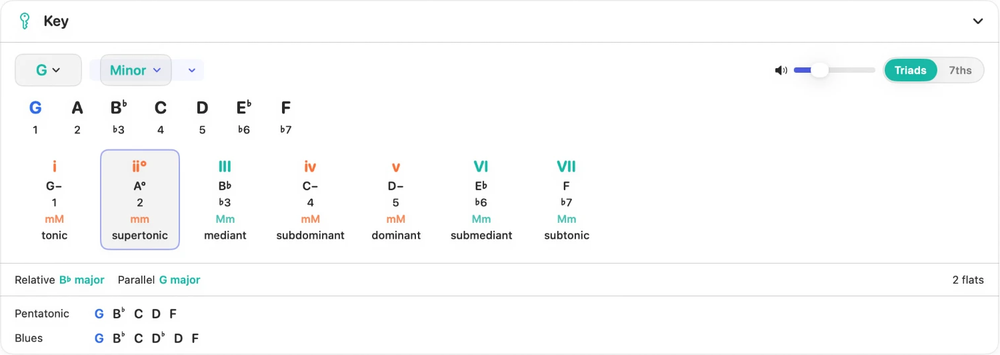
The top row
- Tonic
- The note button opens a grid of all seven letters, each as flat, natural or sharp, so you can choose F♯ or G♭, C♯ or D♭. The key you pick is spelled from that note.
- Mode
- Nine scales, in this order: major; natural minor, harmonic minor and melodic minor; then the modes dorian, phrygian, lydian, mixolydian and locrian.
- Volume
- The slider sets the volume for every play button in the app. On iPhone it sits on its own line under the menus.
- Triads / 7ths
- Switches the chord row between three-note chords and four-note seventh chords. The setting also decides which chords the Progressions panel's Add row offers.
The scale row
The seven notes of the scale, spelled correctly for the key, with each note's step underneath: 1 2 3 4 5 6 7 for major, and 1 2 ♭3 4 5 ♭6 ♭7 for natural minor. The tonic is blue. Tap any note to hear it.
Each scale uses every letter once. That is what makes F♯ major end on E♯ rather than F, and it is how a key signature works on paper.
Melodic minor is the one scale that differs going down. The row shows the ascending form, with its raised 6th and 7th, and a line under it explains: classical practice plays neither raised note descending, while jazz keeps the raised 7th.
The chord row
One card for each degree of the scale, left to right from the tonic. Each card stacks five things:
- Roman numeral
- Upper case for a major chord, lower case for minor, ° for diminished and + for augmented. The color follows the chord's quality: teal for major, orange for minor.
- Chord symbol
- Drawn in the notation style you chose in Settings: E♭Δ7 in jazz, E♭maj7 in plain text, or spelled out.
- Scale step
- Which note of the scale the chord is built on, matching the scale row above.
- Stacked thirds
- The chord read as the thirds it is built from, one letter per gap:
Mmajor third,mminor third,ddiminished,Aaugmented. A major triad isMm, a major seventhMmM, a diminished triadmm. - Degree name
- Tonic, supertonic, mediant, subdominant, dominant, submediant, and for the seventh either leading tone or subtonic.
Tap a card to make that chord the current chord everywhere and to hear it. The card for the current chord is outlined.
Leading tone or subtonic
The seventh degree is the leading tone only when it sits a semitone below the tonic and pulls up to it, as it does in major and harmonic minor. When it sits a whole tone below, in natural minor and the flat-seventh modes, it is the subtonic. The card says which.
The footer
- Relative and Parallel
- The relative key shares this key's notes and signature (C major and A minor). The parallel key shares its tonic (C major and C minor). Tap either name to jump there.
- Signature
- At the right, how many sharps or flats the key carries: "3 flats", "No sharps or flats".
- Pentatonic and blues
- The five-note pentatonic and six-note blues scales built on the same tonic, major forms for a major-sounding key and minor forms for a minor one. Tap any note to hear it.
How it works
Every chord on the row is built only from the scale's own notes: start on a degree, then take every other note above it. That is why the qualities fall into a pattern. In any major key it is always major, minor, minor, major, major, minor, diminished; in natural minor it is the same pattern started from the sixth. The numerals let you talk about chords without naming a key, so "ii, V, I" means the same thing in every key.
With the other panels
The key you set here is the same key the Circle of fifths lights, and it decides which notes the Piano and Guitar color as belonging. Starter progressions follow it. Tapping a chord card sets the chord the Chord, Notation, Piano and Guitar panels all show.